Nine Years Without a Record: How Job for a Cowboy Came Back With Moon Healer
In August 2023, a song called "The Agony Seeping Storm" appeared out of nowhere. It was the first new Job for a Cowboy music in nine years. Six months later the band's album Moon Healer reached No. 29 on the US Billboard 200. Comebacks rarely land that well, so it is worth asking how a band that started as a group of Arizona teenagers got there, and where a new listener should begin.
Here is the short version of a long story, plus a look at the artwork that grew out of it.
Where did Job for a Cowboy start?
In Glendale, Arizona, in December 2003. The founding members were about 15 and 16 years old: Jonny Davy on vocals, Ravi Bhadriraju and Andrew Arcurio on guitars, Chad Staples on bass and Andy Rysdam on drums.
The name has no grand meaning behind it. Davy has said it stuck because every generic metal band name was already taken, which is about as honest an origin story as a band can have.
The first release was the Doom EP in December 2005, on King of the Monsters. At that point the band played deathcore, and Doom was later reissued by Metal Blade Records with a bonus track.
What changed with Genesis?
Everything, in sound terms. Genesis came out on May 15, 2007, on Metal Blade, and it moved the band from deathcore into death metal. It entered the Billboard 200 at No. 54, with about 13,000 copies sold in its first week, a strong start for a debut album in heavy music.
The records that followed built on that turn:
- Ruination (July 7, 2009), recorded at AudioHammer in Sanford, Florida, with producer Jason Suecof.
- Live Ruination (EP, November 23, 2010).
- Gloom (EP, June 7, 2011).
- Demonocracy (April 10, 2012).
- Sun Eater (November 11, 2014), the record that brought in the progressive direction people now hear in the band.
The lineup shifted across those years. Bhadriraju left in 2008 for a career in medicine, and Al Glassman joined on rhythm guitar the same year. Tony Sannicandro (lead guitar and backing vocals) and Nick Schendzielos (bass) came in 2011. Today Davy is the only founding member still in the band.
If you want one record to start with from this era, Sun Eater is the natural bridge to what came next; if you want the turning point, go to Genesis.
Why did the band go quiet, and how did it come back?
After Sun Eater, activity slowed right down. There was a single show in 2016, then roughly seven years with no live dates at all.
The return came in steps:
- January 27, 2023: a Blue Ridge Rock Festival show was announced.
- August 28, 2023: "The Agony Seeping Storm" arrived, the first new song in nine years.
- October 24, 2023: Moon Healer was announced, with the single "The Forever Rot".
- January 31, 2024: a third single, "Beyond the Chemical Doorway", followed.
- February 23, 2024: Moon Healer came out and reached No. 29 on the Billboard 200.
Genesis had entered the chart at No. 54 seventeen years earlier; Moon Healer landed at No. 29 after the band had been away from the stage for most of a decade.
What does the Moon Healer era look like?
The artwork around Moon Healer leans into the occult imagery that has long run through the band's look: eyes, horned shapes, robed figures and rings of ornament, in loud colour on dark backgrounds.
Several designs on the Job for a Cowboy store come straight from that world:
- Moon Healer Ritual: the band's logo in a yellow-to-red gradient on the front, with Moon Healer art of wolves and mirrored figures on the back.
- Moon Healer Eye Sphere: a golden ring of eyes around a purple eye standing on clawed legs, with the Moon Healer wordmark and the logo.
- Flooded Coast: a robed figure raising a horned mask over a flooded, burning coast, set inside a gold ring.
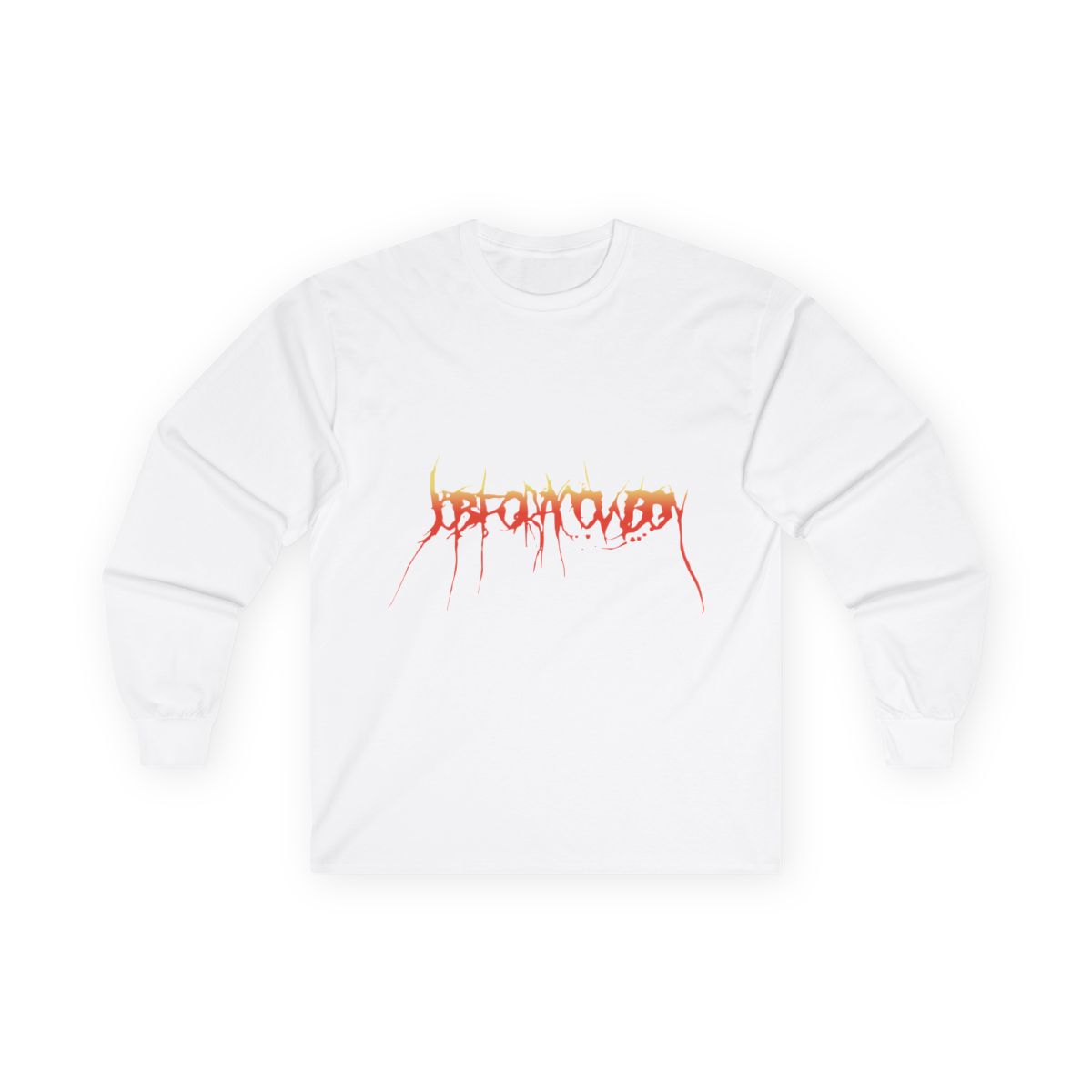
Of the three, the Moon Healer Ritual long sleeve tee is the one that tells the comeback story most directly: the logo up front, the album's artwork across the back, and long sleeves that suit the colder months.
Which other designs are worth a look?
Beyond the Moon Healer pieces, the collection keeps to the same mood:
- Horned Skull: a horned skull with one red-pupilled eye in acid-green splatter, under the logo, in the same acid green as the band's logo lettering.
- Horned Sunburst: a red sunburst of rays and ornament around a white horned skull shape.
- Occult Circle: the red logo over a pale grey circle with a bearded figure, an open book and a star.
- Ornate Frame: a slate-purple woodcut border of scrollwork around a cloaked figure, the quietest design of the set.
- Christmas Knit: the band's name in red capitals between red and green knit-pattern bands of trees and diamonds, on a fleece hoodie and sweatshirts, for anyone who wants a heavy band on a holiday jumper.
Where should a new listener begin?
A simple route through the catalogue:
- Start with Moon Healer (2024) to hear the band as it is now, and to understand why the comeback drew so much attention.
- Go back to Genesis (2007) for the turn from deathcore to death metal that defined the band.
- Then try Sun Eater (2014), which links the two with its progressive side.
More than twenty years on from a teenage band in Glendale, Job for a Cowboy has eight releases, a long run on Metal Blade and a comeback album in the Billboard top 30. The artwork around that story, from the eye sphere to the flooded coast, is a good way to wear it.